The Accessibility Problem in Educational Videos
Video has become the default format for online learning. Lectures, tutorials, onboarding sessions, and microlearning modules increasingly rely on recorded video to deliver instruction at scale.
However, video alone does not guarantee understanding. Learners struggle with unclear audio, unfamiliar accents, noisy environments, or difficulty staying focused. As a result, engagement drops quickly and many learners fail to complete video-based lessons.
AI-powered subtitles address this gap. By converting spoken content into readable, searchable text, subtitles make educational videos easier to follow, easier to revisit, and easier to learn from.
Why Video Alone Fails in Online Learning
Video learning continues to grow rapidly. The global online learning market is expanding at an annual rate of 9.1% through 2026. In the U.S., 99% of teachers now use short-form videos to support instruction.
Despite widespread adoption, effectiveness remains uneven. Engagement drops sharply after six minutes of viewing, and completion rates reveal a clear pattern. Uncaptioned videos average a 66% completion rate, while captioned videos reach 91%, according to BeHooked.
This gap highlights a core issue in digital education. Producing video content is easy, but making it accessible and consumable for all learners requires additional support. Subtitles play a critical role in closing this gap.
Why Subtitles Improve Learning for All Students
Subtitles are often viewed as an accommodation for learners with hearing impairments. In practice, they benefit nearly every learner.
Research summarized by Transcription City shows that subtitles support multiple learning styles. Visual learners benefit from seeing key terms, auditory learners reinforce comprehension through text, and learners with attention challenges stay focused longer when spoken content is anchored visually.
Learning outcomes also improve. One study comparing auto-generated subtitles with no subtitles found higher comprehension and retention among students using subtitles. The study reported no statistically significant difference between auto-generated subtitles and professionally edited captions when measuring learning performance.
This suggests that immediacy and availability matter more than perfect formatting.
For non-native English speakers and English language learners, subtitles provide additional value. They improve vocabulary acquisition, strengthen listening comprehension, and help learners connect spoken language with written forms, leading to deeper and longer-lasting understanding.
How Subtitles Increase Engagement and Completion Rates
Subtitles consistently improve engagement metrics. Adding captions increases viewership by an average of 40%, while captioned videos can increase watch time by up to 12%.
Beyond metrics, subtitles reduce cognitive strain. Learners feel more confident when they can read along, replay specific sections, or scan content without relying solely on audio. This sense of control lowers anxiety and encourages persistence, especially in complex or technical subjects.
AI Transcription Makes Subtitles Fast and Accurate
For many educators, the main barrier to captioning has been time and cost. Manual transcription is slow, expensive, and difficult to scale across multiple courses.
Advances in AI transcription have removed these constraints. According to Wordly, leading AI subtitle systems can reach up to 99% accuracy in ideal audio conditions, with most educational use cases consistently exceeding 95% accuracy.
What once took hours or days now takes minutes. Manual captioning can cost between $50 and $200 per video, while AI-powered tools generate subtitles almost instantly at a fraction of the cost.
TutorFlow’s Video Subtitle Generator, Built for Educators
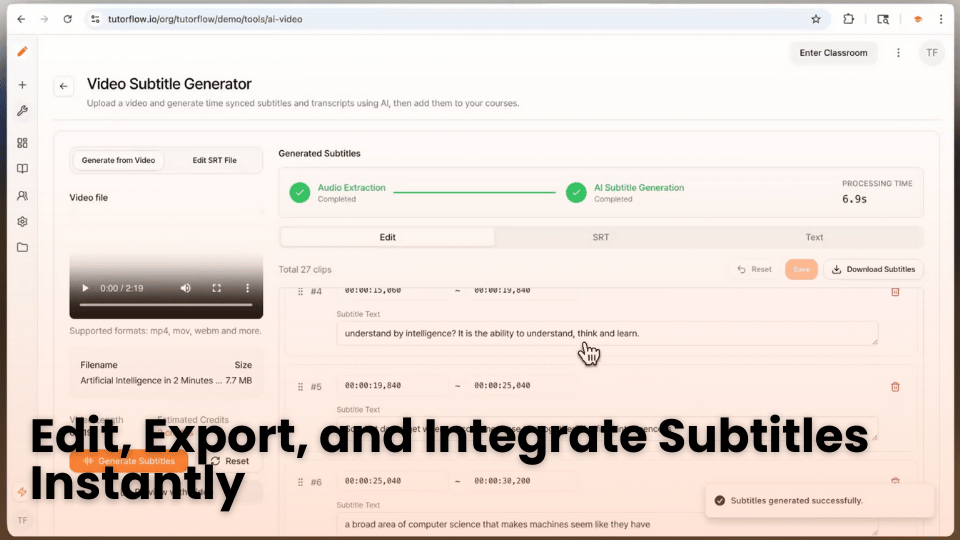
TutorFlow’s Video Subtitle Generator is designed specifically for educational workflows. Educators can upload lecture recordings or instructional videos, automatically generate subtitles, and review or edit them directly in the browser.
Subject-specific terminology, technical language, and proper nouns can be corrected easily. Subtitles can be previewed in sync with the video to ensure timing and accuracy before publishing.
Multiple export formats allow subtitles to be integrated seamlessly into learning management systems, video platforms, and course materials, enabling instructors to deploy accessible content immediately.
Subtitles as Core Infrastructure for Online Learning
AI-powered subtitles are no longer optional in online education. They improve comprehension, increase engagement, support diverse learners, and help institutions meet accessibility expectations.
For educators, subtitles are not about adding extra work. Modern AI tools make captioning fast, accurate, and scalable. As video continues to dominate online learning, accessible subtitles are becoming a baseline requirement, not a feature.
Start Now With TutorFlow
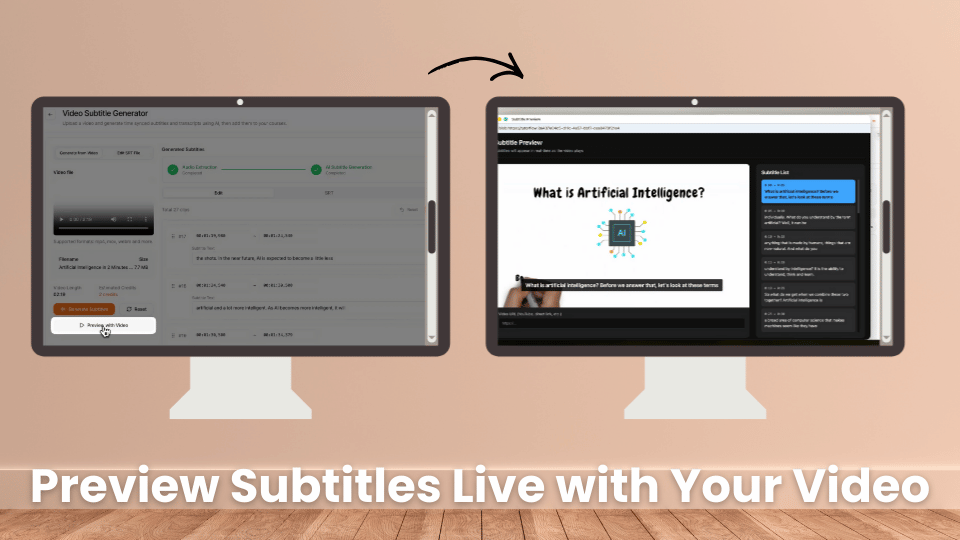
Accessible video is now a standard expectation in education. TutorFlow’s Video Subtitle Generator helps educators caption videos quickly and deliver more inclusive learning experiences.
Try the Video Subtitle Generator: