
The Shift Toward Intelligent Instruction in 2026
By 2026, the global education sector has moved beyond early experimentation with artificial intelligence. The central question is no longer whether AI belongs in education, but how it fundamentally reshapes teaching workflows and instructional design.
This transition marks a maturation of EdTech. AI is no longer positioned as a standalone productivity feature. Instead, it functions as an infrastructural layer that influences how learning objectives are defined, how knowledge is structured, and how instruction adapts over time.
As a result, teaching is increasingly understood not as content delivery, but as the design and orchestration of learning systems.

From instructional intent to executable learning design, bridging planning and practice.
For educators, this evolution shifts professional focus away from administrative maintenance toward higher-impact instructional work. Traditional workflows require constant effort to manage documents, update materials, and synchronize disconnected platforms.
Modern AI-powered instructional systems prioritize alignment. Learning objectives, activities, and assessments are structurally connected, reducing fragmentation and manual reconciliation.
Institutions adopting workflow-centered instructional models report that educators reclaim 10 to 12 hours per week. More importantly, this time is redirected toward instructional design, formative feedback, and learner engagement.
The Efficiency Gap in Traditional Teaching Workflows
Despite decades of digital tools, the core mechanics of teaching workflows remain largely unchanged. Planning, delivery, assessment, and iteration are often managed in isolation, creating fragmented instructional systems.
This fragmentation produces a widening efficiency gap between pedagogical intent and day-to-day execution.
1. The Administrative Tax on Teaching Creativity
Manual curriculum mapping, repeated content updates, and cross-platform coordination impose a persistent operational burden.
- Teacher burnout and turnover continue to rise, with workflow fatigue cited as a primary contributor.
- Educators report that preparation time is increasingly spent on material management rather than instructional strategy.
These challenges are structural, not individual. They stem from systems designed to store content rather than preserve instructional coherence.
2. Passive Learning and Retention Loss
Traditional workflows emphasize content delivery, often resulting in passive learning experiences. Research consistently shows a gap in outcomes:
- Passive consumption such as lectures and reading leads to low long-term retention.
- Active participation through application and practice leads to higher retention and transfer.
While active learning is widely accepted as effective, scaling it has historically required time, coordination, and instructional overhead that many educators cannot sustain.
Instructional systems designed as connected knowledge flows rather than isolated lessons.
From AI-Assisted Tools to AI-Native Instructional Systems
By 2026, the distinction between AI-assisted tools and AI-native instructional systems has become clear.
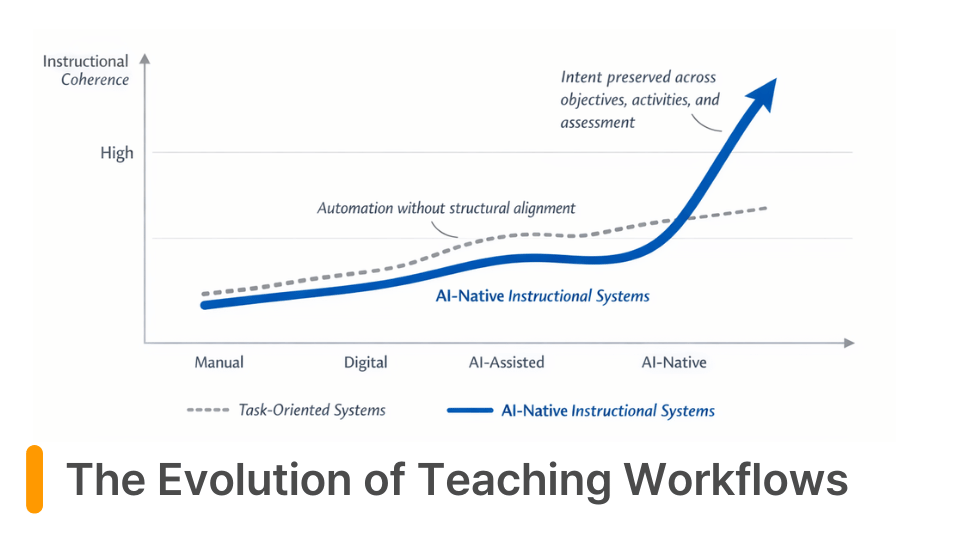
From task-level automation to AI-native instructional architecture.
AI-Assisted Tools: Task Optimization
AI-assisted tools improve efficiency by automating individual tasks such as content generation, summarization, or quiz creation. However, they lack awareness of instructional context.
Educators must still manually ensure alignment between objectives, activities, and assessments.
AI-Native Instructional Systems: Structural Coherence
AI-native systems embed intelligence directly into the teaching workflow. Instruction is modeled as an interconnected structure rather than a collection of isolated artifacts.
- Learning objectives remain continuously linked to activities and assessments.
- Content adapts in response to instructional intent.
- Alignment is preserved as courses evolve.
The value of AI-native design lies not in automation alone, but in maintaining instructional coherence at scale.
| Dimension | AI-Assisted Tools | AI-Native Instructional Systems |
|---|---|---|
| Primary Role | Task automation | Instructional architecture |
| Instructional Context | Not preserved | Continuously modeled |
| Alignment | Maintained manually | Structurally maintained |
| Adaptation Over Time | Limited | Intent-driven |
| Scalability | Increases complexity | Preserves coherence |
| Educator Workload | Reduced per task | Reduced structurally |
Systems that model instructional intent consistently outperform tools that optimize isolated tasks, especially at scale.
Translating Instructional Theory Into Practice
As this shift accelerates, a new class of platforms has emerged to operationalize AI-native instructional design. These systems translate pedagogical intent into structured, adaptable learning workflows without enforcing a single teaching methodology.
TutorFlow was developed within this AI-native paradigm.
Rather than centering on content production, TutorFlow is built around intent-driven teaching workflows. Educators begin by defining learning objectives, learner context, and desired depth of understanding. These inputs form the structural backbone of the course.
What distinguishes this approach is its focus on alignment over time. As instructional goals evolve due to learner performance, curriculum changes, or contextual constraints, the system propagates updates across the workflow. Objectives, activities, and assessments remain synchronized as part of a single instructional system.
In practice, this allows educators to treat courses as adaptive systems rather than static documents. Instructional design becomes a continuous refinement process supported by an underlying architecture that preserves coherence as complexity increases.
This reframes course creation from document assembly to instructional architecture, prioritizing clarity, adaptability, and intent.

Scaling instructional quality while keeping learners actively engaged.
Scaling Instructional Quality Without Losing Pedagogical Intent
As institutions expand programs and serve more diverse learners, maintaining instructional quality becomes increasingly complex. AI-native workflows offer a scalable solution without sacrificing coherence.
Key considerations include:
- Preserving instructional intent
Growth should not dilute pedagogical purpose. - Designing for adaptation
Curricula should evolve as living systems, not fixed artifacts. - Using data as a design signal
Engagement and performance data should inform structural adjustments, not just reporting.
Conclusion: Protecting the Human Core of Teaching
The purpose of AI-powered EdTech tools for modern teaching workflows is not to replace educators or standardize instruction.
Their value lies in reducing structural friction so educators can focus on judgment, mentorship, and meaningful human interaction.
As education continues to evolve, the most effective institutions will not be those that adopt the most technology, but those that use technology to preserve and amplify the human core of teaching.