
AI in education in 2026 is less about replacing teachers and more about deciding where AI can improve preparation, practice, feedback, and access without weakening human judgment.
The evidence is promising in specific settings, but it is not uniform. UNESCO's 2025 review describes both opportunities and unresolved risks, including unequal access, weak governance, privacy concerns, and the need to keep teachers and learners at the center of decisions. That makes careful implementation more useful than broad claims about transformation.
This article examines five practical trends educators and training teams can act on now.
What changed in AI and education by 2026?
The main change is a shift from experimentation to operational use. Educators are testing AI inside repeatable workflows such as lesson preparation, content adaptation, formative feedback, and guided practice. At the same time, institutions are adding review processes for accuracy, privacy, accessibility, and academic integrity.
The result is not one universal model. Effective use depends on the subject, the teaching goal, the quality of the content, and the amount of human oversight.
1. AI is becoming part of the educator workflow
AI can help educators create a first draft of a lesson outline, turn source material into practice questions, adapt an explanation for a different level, or summarize patterns in assessment results. These uses can reduce repetitive preparation work, but the output still needs professional review.
UNESCO's AI competency framework for teachers organizes teacher capability across five areas: a human-centered mindset, ethics, AI foundations and applications, AI pedagogy, and professional learning. The framework is a useful reminder that prompt writing alone is not enough. Educators also need to evaluate whether a tool is appropriate, accurate, fair, and aligned with the learning objective.
Practical uses include:
- Drafting lesson and training outlines from approved source material
- Creating question variations for formative practice
- Adapting reading level or format while preserving the core concept
- Summarizing recurring errors for an educator to review
- Producing slides, videos, and tests within a consistent course structure
2. Structured tutoring matters more than a generic chatbot
An AI response is not automatically good instruction. Useful tutoring requires clear objectives, carefully sequenced questions, hints that support thinking, and limits that prevent the system from simply giving away an answer.
A 2025 randomized controlled trial published in Scientific Reports found that students using a research-based AI tutor in a specific undergraduate physics course learned more in less time than students in an in-class active learning condition. The authors also caution against generalizing the result to every subject, course, or AI tutor.
That distinction matters. The strongest lesson from the study is not that any chatbot improves outcomes. It is that instructional design, guardrails, and alignment with course material can materially change the quality of an AI-supported activity.
3. Hands-on STEM practice remains the value test

STEM subjects expose the difference between plausible output and verified understanding. A generated explanation may sound correct while containing a logical, mathematical, or coding error. Students still need opportunities to run code, show their work, test a hypothesis, and explain why an answer is valid.
AI can support hands-on practice when it is placed around the activity rather than used as a substitute for it. Examples include:
- Providing a hint after a learner attempts a coding problem
- Explaining a compiler error without completing the entire task
- Converting a handwritten equation into editable notation for review
- Generating an additional practice problem tied to the same objective
- Comparing a learner's reasoning with an instructor-approved rubric
For educators, the important design question is simple: does the tool create another opportunity to think and practice, or does it remove the thinking from the task?
4. Governance and AI literacy are core requirements
UNESCO's report on AI and the future of education emphasizes a human-centered approach and warns that the benefits of AI may be distributed unevenly. Access, language coverage, data protection, teacher preparation, and local context all affect whether an implementation helps or excludes people.
Before adopting an AI tool, an institution should be able to answer:
- What educational or training problem are we trying to solve?
- What data does the tool receive, retain, or use?
- Who reviews generated content before it reaches learners?
- How can a learner or educator challenge an incorrect result?
- What happens when the tool is unavailable or performs poorly?
- How will we evaluate impact beyond time saved or content produced?
These questions turn responsible AI from a policy statement into an operating practice.
5. Evaluation is moving from output volume to evidence
The number of generated lessons, quizzes, or videos does not show that instruction improved. A useful evaluation connects the AI-supported workflow to observable evidence.
Depending on the goal, teams can track:
- Preparation time saved after human review is included
- Error rates found during content quality checks
- Completion and retry patterns in formative activities
- Changes in the quality of learner explanations or submitted work
- Educator confidence and control over the final material
- Accessibility and participation across different learner groups
Start with a small use case and a clear baseline. If the result cannot be reviewed or measured, expanding the tool will make uncertainty larger, not smaller.
A practical 2026 adoption checklist
Use this sequence before rolling an AI workflow out across a course or training program:
- Choose one narrow problem with a measurable baseline.
- Use approved source material and define what the AI may generate.
- Require educator review for factual, instructional, and accessibility quality.
- Test with a small group and record both benefits and failure cases.
- Provide a non-AI path when access or reliability is a concern.
- Review privacy, retention, and vendor terms before sharing personal data.
- Expand only when evidence supports the next step.
How TutorFlow fits the educator workflow
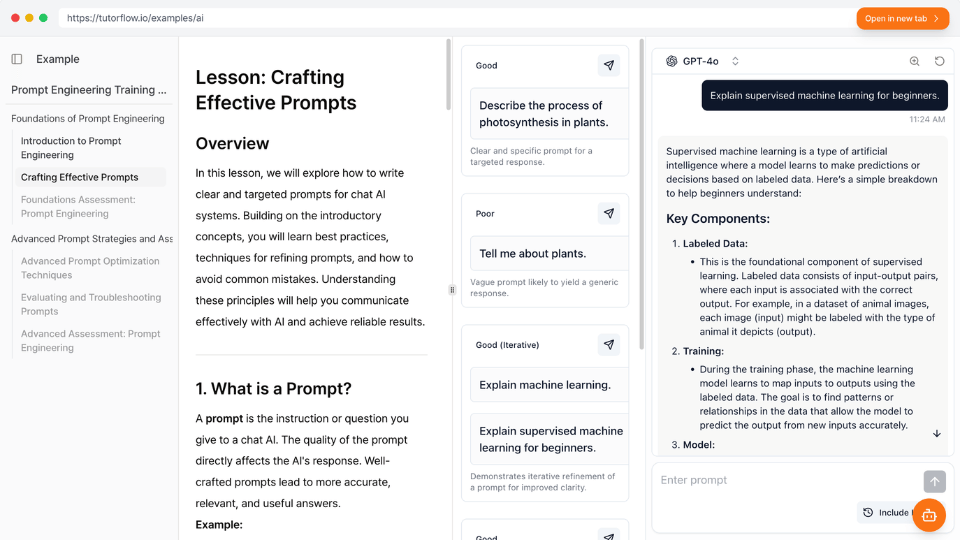
TutorFlow helps educators and training teams create and manage courses, videos, slides, tests, and live classrooms in one workspace. Interactive coding and mathematics content can sit alongside the rest of a course, which reduces the need to move material between unrelated tools.
For example, an educator can use AI to draft a course structure, review and revise the generated material, add interactive practice, and deliver the finished content from the same workspace. TutorFlow's math OCR tool can also convert handwritten equations into editable digital notation. The educator remains responsible for the final instructional decisions and published content.
The goal is not to automate teaching. It is to give educators a more connected way to author, deliver, and improve their work.
Conclusion
The most credible AI in education trend for 2026 is disciplined adoption. Structured tutoring can help in well-designed contexts, educator workflows can become more efficient, and interactive tools can support more practice. None of those benefits removes the need for evidence, subject expertise, accessibility, privacy, and human judgment.
Institutions that start with a real teaching problem, test a bounded use case, and measure what changes will be better positioned than teams that adopt AI because it is available.