Faculty have a problem. Students are using AI. AI detectors promise to catch them. And every "best AI detector" comparison published in 2026 was written by a vendor with a horse in the race, so the picture is murky.
This comparison is different in one specific way. We are TutorFlow, and we built our own AI detector. So we have skin in the game too. The difference is that this article will tell you where TutorFlow falls short and where another tool fits your campus better, because no single detector wins on every dimension that matters to a higher-education institution.
If you teach a hundred undergraduates, you already know the constraint. You cannot afford a tool that returns ten false positives a week. You also cannot afford to ignore submitted work that was clearly written by a chatbot. The realistic 2026 answer is a mix of detection, assignment redesign, and FERPA-aligned vendor practices. Detection is part of the answer. It is not the answer.
The hard truth about AI detection in 2026
No AI detection tool is reliable enough to fail a student on its own.
Multiple peer-reviewed studies in 2024 and 2025 reported false-positive rates between 1 and 9 percent across major detectors, with significantly higher rates on writing from second-language students. OpenAI shut down its own AI Text Classifier in 2023 for the same reason. The next generation of tools improved on the median case and did not meaningfully improve on the edge cases.
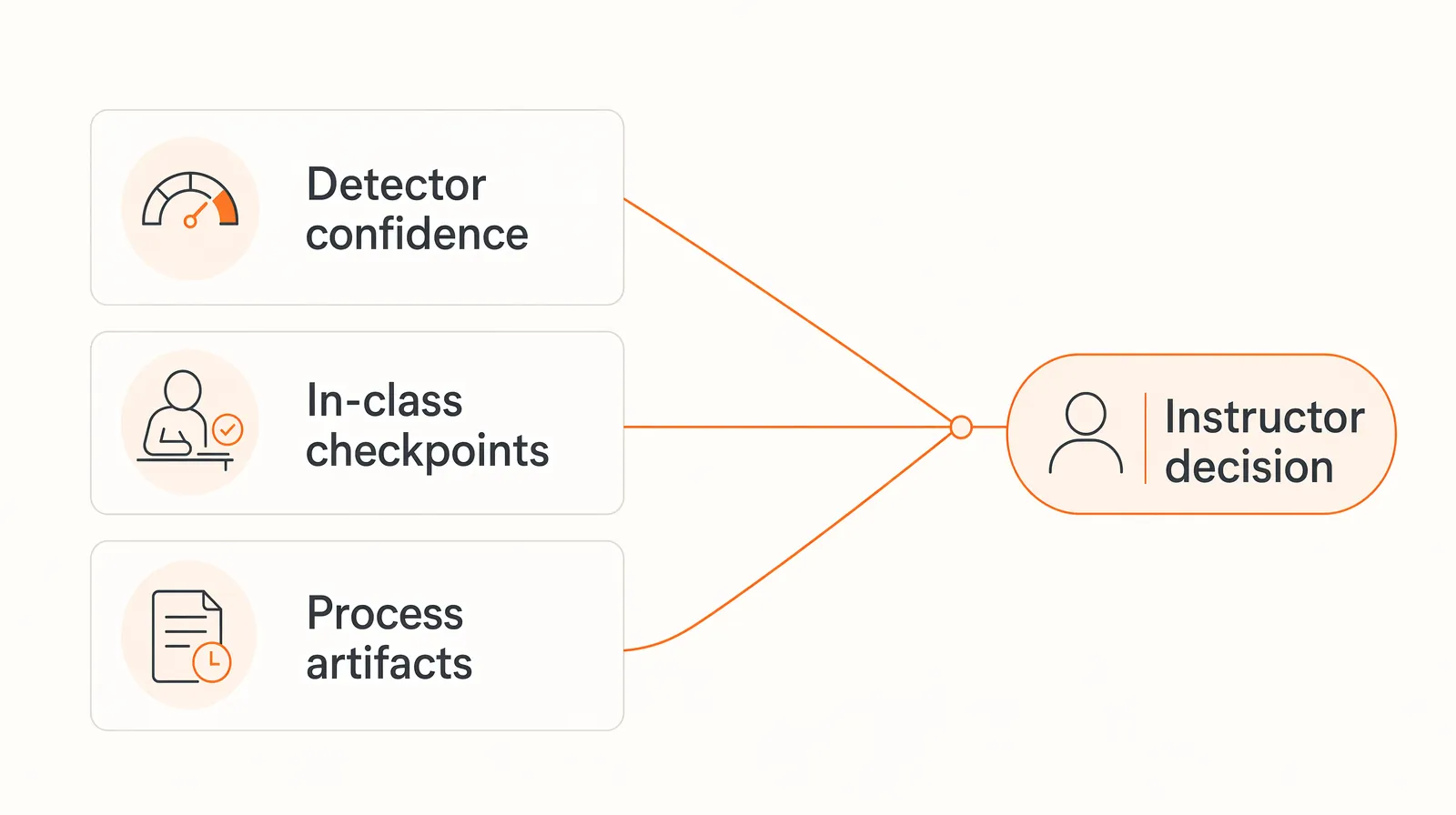
What changed in 2026 is the workflow, not the model. The strongest higher-ed campuses now treat AI detection as one of three signals: detector confidence, in-class checkpoints, and process artifacts like draft history. The detector alone never decides. It opens a conversation with the student.
That framing matters for your tool selection. You are not buying a verdict machine. You are buying triage software. The right detector is calm, integrates cleanly into your LMS, logs every check for FERPA, and respects that the final call belongs to the instructor.
How to read this comparison
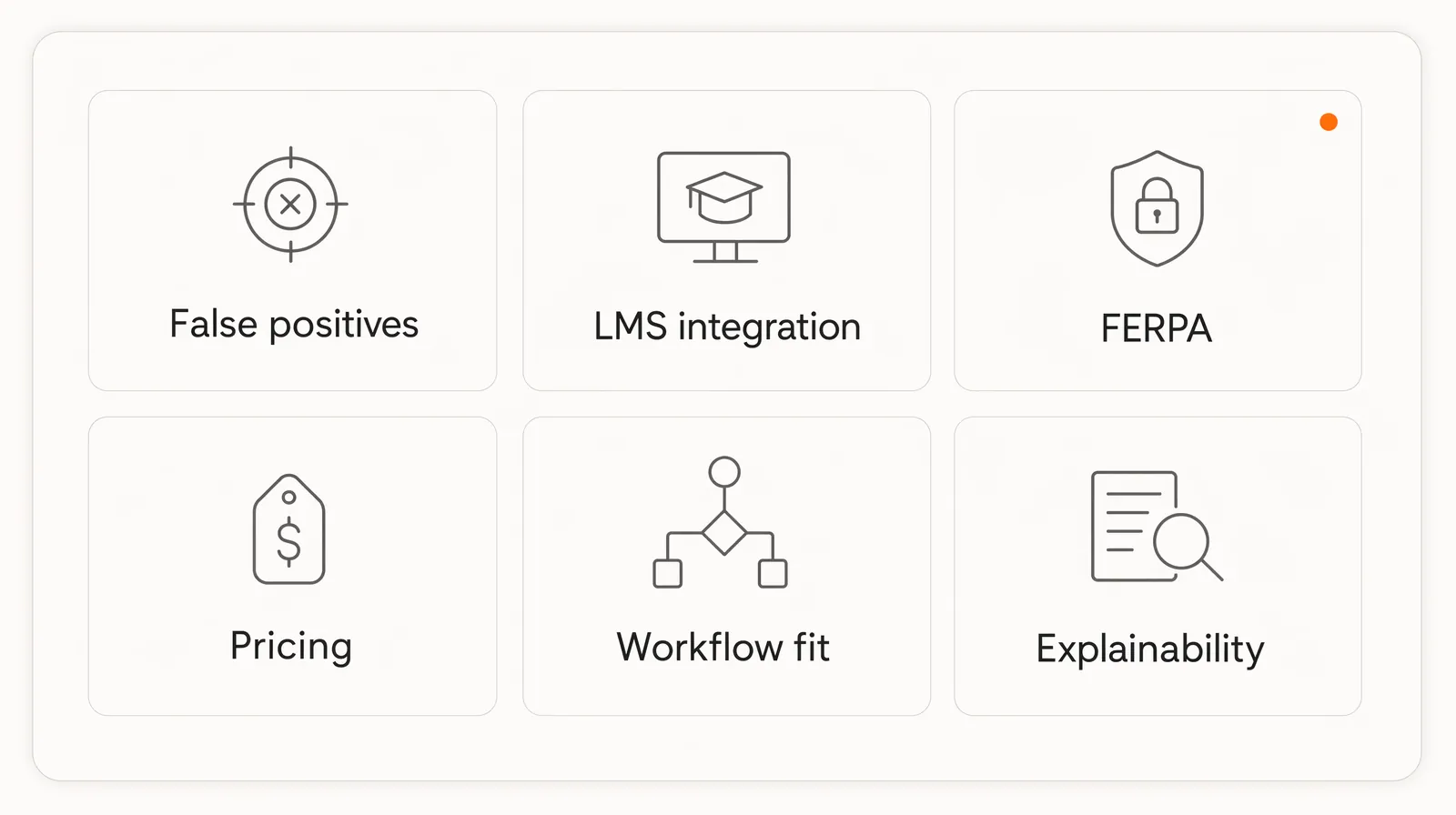
We scored each tool on six dimensions that map to what universities actually need in 2026:
- False-positive posture, including how clearly the vendor communicates uncertainty
- LMS integration, Canvas first, then Blackboard, D2L Brightspace, and Moodle via LTI 1.3
- FERPA-aligned data practices, including audit logs and a clear statement on training on student work
- Pricing reality, per-instructor or per-institution, and whether the public price actually applies to a department
- Workflow fit, whether the detector reads inside an existing assignment flow or asks for copy-paste
- Override and explainability, whether the instructor can see why the model flagged a passage
We did not score tools on which one feels best in a marketing demo. Demos are unrelated to the messy reality of grading sixty assignments on a Thursday night.
The top 10 AI detection tools for universities in 2026
1. Turnitin
Best for institutions that already license Turnitin Originality. AI Writing Detection is bundled into existing seats, and the LMS integration is the most mature on the market. The downside is cost. Universities pay low five figures and up for full Originality access. Turnitin publishes confidence percentages but does not surface passage-level scoring in a way that feels easy to override.
2. GPTZero
Best for individual instructors and small departments. The Origin product is cheap, browser-based, and recognized as a reasonable middle-of-the-pack option in independent benchmarks. Pricing is transparent and the free tier covers evaluation. The weakness is enterprise polish. There is no production LMS integration on par with Turnitin, and the workflow expects copy-paste rather than living inside the assignment.
3. Originality.ai
Best for writing-heavy programs that want a detector tuned for essay and long-form output. Confidence reporting is clearer than most. The product was built primarily for content publishers, so the higher-ed positioning feels secondary. No native LMS integration. Per-credit pricing scales unfavorably at department volume.
4. Copyleaks
Best for institutions that need plagiarism and AI detection in one product. LMS integration is solid. The product is enterprise-ready and competes directly with Turnitin in the procurement conversation. Pricing is opaque without a sales call, which is a friction point for community colleges and smaller institutions.
5. Winston AI
Best for newer departments that want a modern UI and clear confidence reporting. Winston publishes per-passage scoring and has improved its handling of non-native English in the last year. The trade-off is brand familiarity. Faculty senates that already standardized on Turnitin will resist switching on a marketing review alone.
6. Sapling
Best for institutions running large written-feedback or chat-based programs. Sapling started in writing assistance and added AI detection. It is strong on real-time integration with chat-style submissions and weaker on long-form essay analysis compared with specialists.
7. ZeroGPT
Best for free triage. ZeroGPT has a generous free tier that small departments use to spot-check work before deciding whether to escalate. Accept that the free tier is not a license-grade product. Confidence reporting is thin and there is no audit log a registrar would accept.
8. AI Detector by Scribbr
Best for instructors who already use Scribbr for citation and grammar feedback. The detection product is a sensible add-on. It was not designed to be the campus-wide policy tool. Treat it as a check, not a system of record.
9. CrossPlag
Best for institutions in regions where Turnitin pricing is unworkable. CrossPlag is built for academic-integrity offices and integrates with most LMSs. Reporting is solid for compliance purposes. The product feels less polished than Turnitin, which can slow faculty adoption.
10. TutorFlow AI Detector
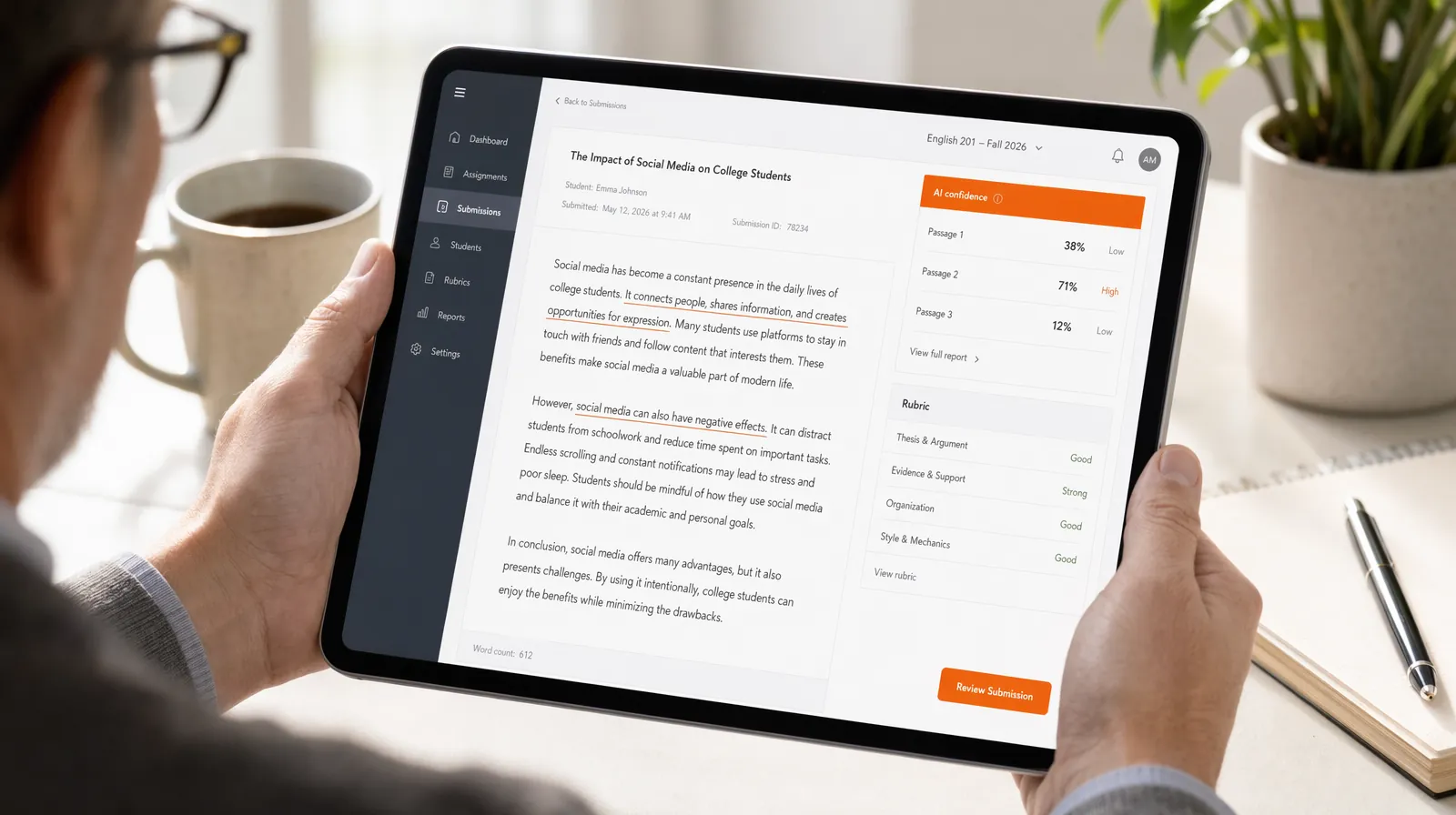
Best for educators who want detection inside the same workspace where they author the course, assign work, and grade. Our positioning is honest. We are not a Turnitin replacement at the campus contract level today. We are the right pick when an instructor is already authoring lessons, assignments, and rubrics inside TutorFlow and wants a one-click check before grading begins. The detector is FERPA-aligned, returns confidence per passage, and never trains on student work. If your goal is a single campus-wide contract, look at Turnitin or Copyleaks first.
What no AI detector can replace
Even with the best tool on this list, two practices do more for academic integrity than any detector.
The first is assignment redesign. Replace one of every three long-form essay assignments with a deliverable that produces process artifacts: a recorded presentation against a rubric, a code submission with a live walkthrough, or a problem set with documented steps. AI is harder to use when the assignment requires the student to show their process.
The second is the conversation. When a detector flags a submission, the right move is a short office-hour conversation, not a unilateral grade penalty. Faculty who have tried both report that the conversation alone catches the majority of true cases the detector flagged and prevents the false positives from becoming formal complaints.
How to pick the right tool for your campus
The right tool depends on the institutional reality you are buying into, not the detector with the best benchmark slide.
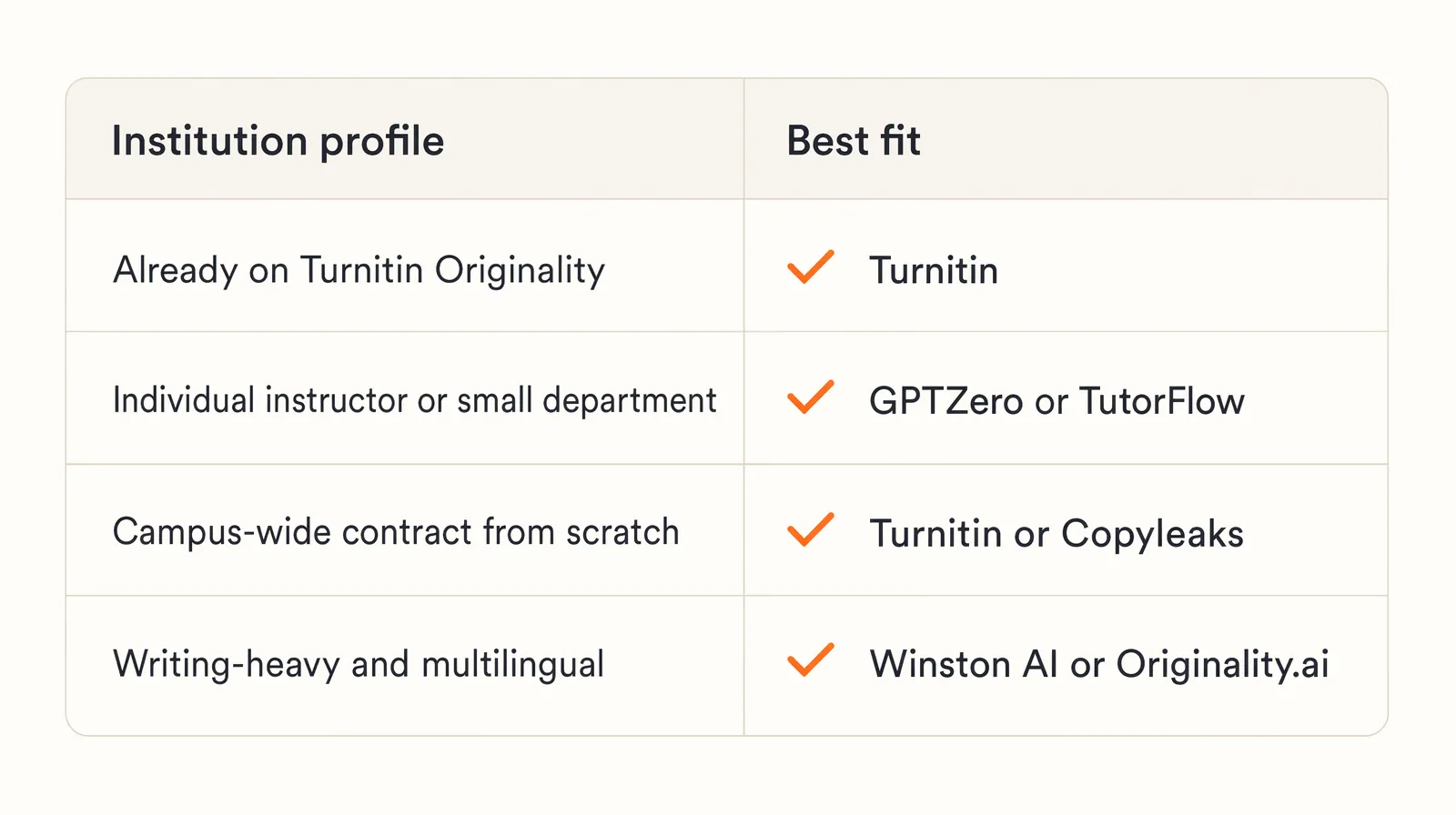
- If you already license Turnitin Originality, start there. The integration cost of switching is real, and Turnitin's AI detection is competitive enough.
- If you are an individual instructor or a small department, GPTZero or TutorFlow AI Detector are the lower-friction starting points.
- If you are evaluating a campus-wide contract from scratch, run Turnitin and Copyleaks side by side on a sample of two hundred recent submissions. Insist on per-passage scoring before you sign.
- If your program is writing-heavy and serves multilingual students, ask each vendor for documented false-positive rates on non-native English samples. Reject vendors who cannot answer.
- If you already author your courses inside TutorFlow, use our detector for first-pass triage and pair it with the office-hour conversation pattern.
FAQ
Is any AI detector reliable enough to fail a student outright?
No. The honest 2026 answer is that detection should trigger a conversation and a request for process evidence. A grade penalty should be the result of the conversation and the evidence, not the detector's confidence number on its own.
Do AI detection tools train on student work?
That depends on the vendor's data policy. Turnitin, Copyleaks, and TutorFlow publish no-training-on-customer-data policies. Some smaller detectors do not. Read the data processing addendum before you sign, and ask for a FERPA-aligned addendum for US institutions.
How does TutorFlow's AI detector fit alongside an existing LMS?
TutorFlow connects to Canvas, Blackboard, D2L Brightspace, and Moodle via LTI 1.3 and SCORM. Instructors keep students in the LMS for sign-in and run detection inside TutorFlow when they author or grade. The detection is FERPA-aligned and logs every check for audit.
The shape of academic integrity in 2026
The best AI detection tool is the one that integrates calmly into a workflow that does not depend on it. Choose the detector that fits how your faculty actually teach and grade, not the one with the highest single-benchmark score in a vendor deck. And keep the conversation with the student at the center. That is the only part of the workflow no model can do for you.
If you want to see how AI detection feels when it lives inside the same workspace as course authoring, assignment design, and grading, try the TutorFlow AI detector. Free for individual instructors. No campus contract required.