"AI in education" has become a phrase that means everything and nothing. For the educator, trainer, or L&D lead actually shipping courses, the useful question is narrower: where does AI remove real hours of work, and where does it quietly create new ones? This guide skips the trend predictions and focuses on the two places AI changes your week the most, course creation and assessment, plus how to decide what to hand over and what to keep.
Why most "AI in education" advice misses the teacher
Most of the conversation is written for learners. It talks about personalized tutoring, study companions, and homework help. That is a real shift, but it is not your shift. If you build and deliver training, your day is spent producing material, structuring it into something teachable, writing assessments that actually measure understanding, and then maintaining all of it as content goes stale.
AI changes that production layer first, long before it changes how any individual learner studies. So the practical framing is not "will AI teach my students." It is "how much of my course-building and grading work can I compress without lowering the quality my name is attached to." That reframing is what turns a vague trend into a workflow decision.
What AI actually changes in course creation
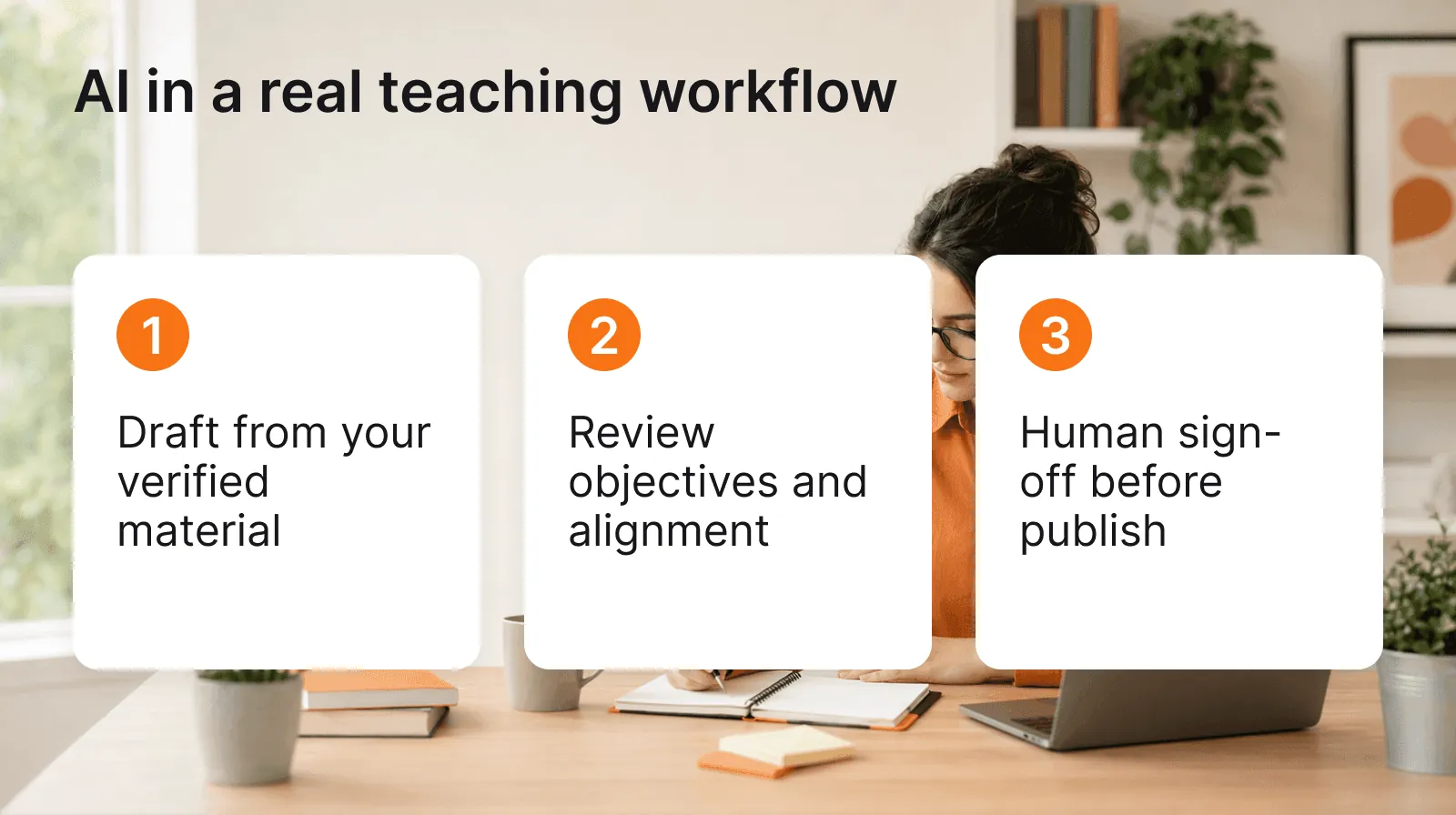
The biggest gain is not "AI writes my course." It is that AI collapses the blank-page and restructuring stages, which is where most educators lose time.
Concretely, AI is strong at turning raw material you already trust (your notes, a transcript, a slide deck, a reference document) into a first-pass structure: a module outline, learning objectives per section, a draft script, and suggested examples. That first pass is rarely final, but going from a rough draft to a polished course is far faster than going from nothing to a rough draft.
Here is the operational distinction that matters. AI-assisted course creation is reliable when you supply the source of truth and ask it to reshape, sequence, and clarify. It is risky when you ask it to supply the facts. A worked example: feeding in your own 40-minute lecture transcript and asking for a tightened 6-module outline with objectives is a safe, high-leverage task. Asking it to "write an authoritative module on tax law for 2026" with no source is how errors get baked into your material.
The decision criterion is simple. If a mistake in this section would embarrass you or mislead a learner, you provide the source and you review the output. If the section is structural or stylistic (ordering, transitions, summaries, rephrasing for a different audience), you can lean on AI much harder.
What AI changes in assessment, and where it gets dangerous
Assessment is where AI is both most useful and most misused. Useful, because writing good questions is slow and AI can draft many variations quickly. Dangerous, because a plausible-looking question can be subtly wrong, ambiguous, or testing recall when you meant to test reasoning.
The honest split looks like this. AI is genuinely helpful for generating question drafts at volume, producing distractors for multiple choice, rewriting a question at three difficulty levels, and turning one scenario into several parallel versions so cohorts do not share identical tests. AI is weak, and needs you, at deciding what is worth assessing, calibrating difficulty against your real audience, and judging whether a question rewards understanding or just memorization.
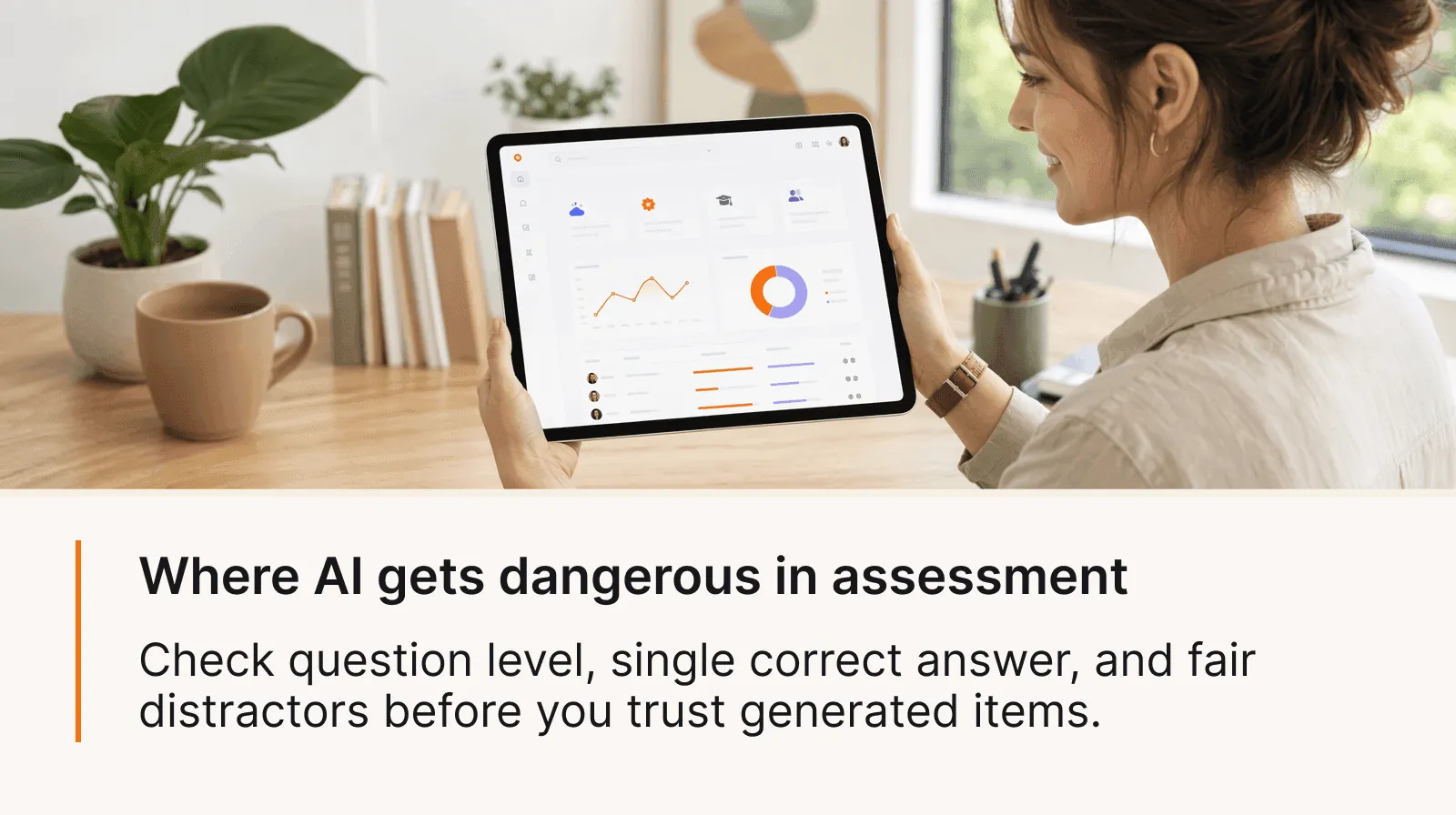
A practical pattern that works: use assessment generation to produce more candidates than you need, then cut hard. If you want 10 final questions, have it draft 25 and keep the strongest 10. The drafting is cheap; your judgment is the scarce resource, and this pattern spends it on selection rather than creation. The same applies to rubrics. AI can propose a rubric structure quickly, but you decide the weightings, because weightings encode what you actually value.
One caution worth stating plainly: do not let AI both write the assessment and be the sole grader of open responses without spot-checks. Automated scoring of free text can drift, and a single miscalibrated rubric scales errors across every learner at once.
A practical checklist before you ship AI-assisted material
Run through this before any AI-assisted course or assessment goes live. It is short on purpose, because a checklist you actually use beats a thorough one you skip.
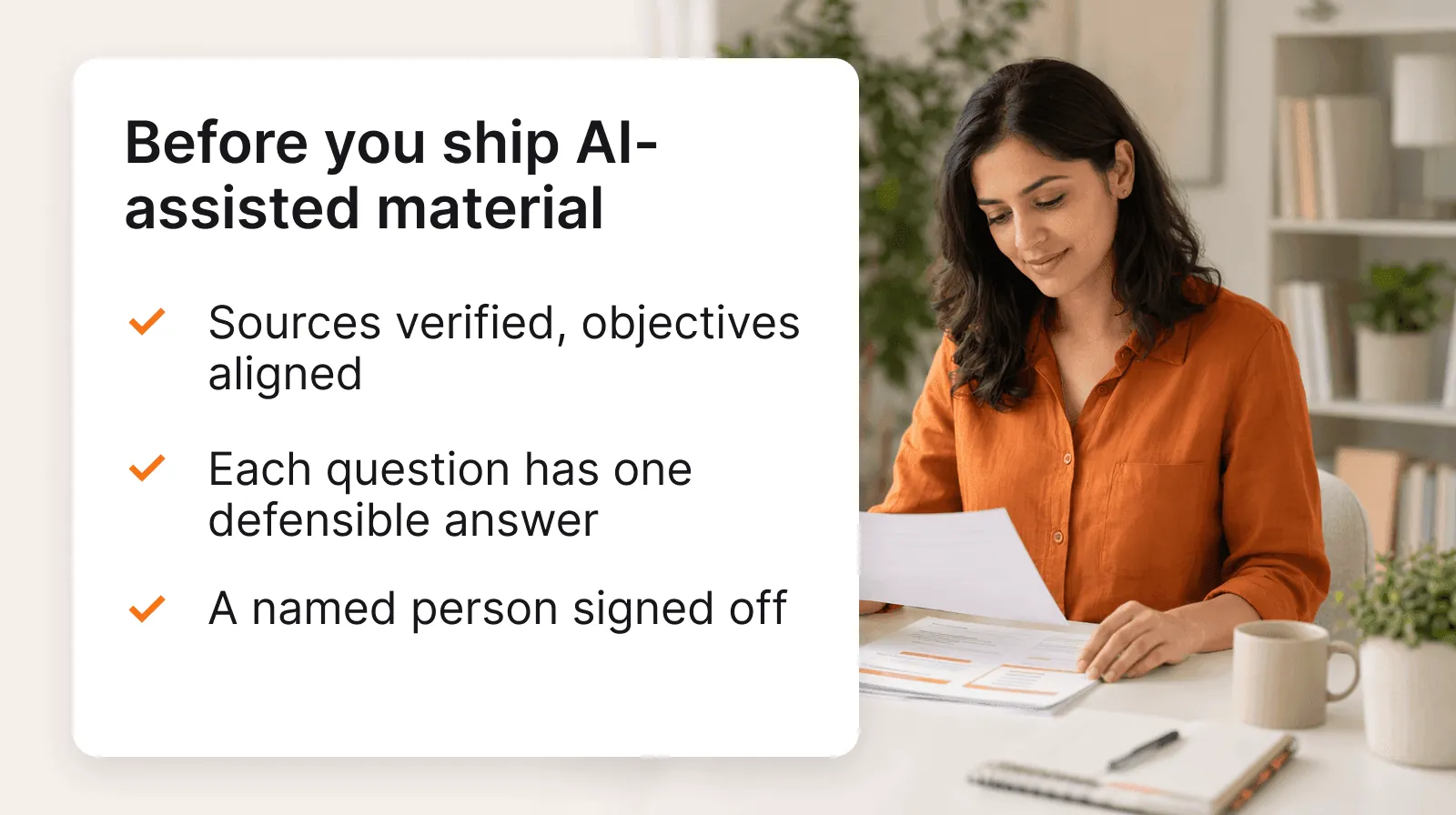
- Source verified: every factual claim traces back to material you provided or independently confirmed, not to the model's general knowledge.
- Objectives match content: each module's stated learning objective is actually taught and actually assessed.
- Assessment alignment: questions test the level you intended (recall vs application vs reasoning), not whatever was easiest to generate.
- Ambiguity pass: each question has exactly one defensible correct answer, and distractors are wrong for a clear reason.
- Tone and audience fit: the voice matches who you are training, with no generic filler or hallucinated specifics.
- Accessibility and inclusivity: examples, names, and scenarios are appropriate and do not assume one narrow context.
- Human sign-off recorded: a named person reviewed and approved before publish, so accountability is never the model's.
How this fits a real training workflow
The teams that get value from AI in education are not the ones that automate the most. They are the ones that draw a clear line between drafting and deciding. AI owns the drafting: outlines, scripts, question banks, rubric scaffolds, alternate versions. The educator owns the deciding: what is true, what is worth teaching, what counts as mastery, and what ships.
In a platform context, this is why AI-assisted course creation, assessment generation, and training content workflows belong in the same place. When your source material, your generated drafts, and your review step live together, the review actually happens, because it is one click from the draft rather than a separate chore in a separate tool. The workflow gain compounds over time too: as you build a library of trusted source material, each new course leans on assets you have already vetted, so the AI is reshaping known-good content rather than inventing from scratch.
The realistic outcome of adopting AI well is not a course that builds itself. It is the same quality you would have produced, reached in a fraction of the time, with your judgment concentrated exactly where it matters. That is the version of "AI in education" worth caring about, because it changes your workflow without putting your name behind something you did not actually check.
Frequently asked questions
Will AI lower the quality of my courses and assessments?
Not if you keep humans on the decisions that carry your name. Quality drops when AI is treated as a source of truth or a final grader. It stays high, and your output rises, when AI drafts and you verify facts, alignment, and difficulty before anything ships.
Should I let AI grade student work automatically?
For structured items like multiple choice, automated grading is fine. For open-ended responses, use AI to assist and accelerate, but keep spot-checks and a human-owned rubric. A single miscalibrated rubric applied automatically can scale one mistake across every learner.
What is the fastest place to start with AI in my workflow?
Start with restructuring material you already trust. Feed in your own notes, transcripts, or decks and ask for outlines, objectives, and draft questions. This is the highest-leverage, lowest-risk entry point because you supply the facts and AI handles the time-consuming shaping.