
AI Grading That Faculty Actually Trust: Rubrics, Overrides, and Audit Trails
The faculty concern around AI grading in higher education is not usually “Can AI write feedback?” It is “Can I trust the process enough to put my name on the grade?”
That distinction matters. A one-shot ChatGPT prompt can produce confident feedback, but it does not give an instructor a durable grading workflow. It may ignore the rubric, drift across submissions, overvalue fluent writing, or provide no clear record of why a score was suggested. Faculty are right to be cautious.
A trustworthy AI grading workflow should be structured differently: rubric-first, instructor-overrideable, and audit-logged. In TutorFlow’s product context, the goal is not to replace academic judgment. It is to reduce repetitive grading work while preserving the instructor’s control over criteria, scoring, feedback, and final release.
The wrong model: “Paste this essay into ChatGPT and grade it”
The fastest AI grading demo is also the least trustworthy one:
- Paste a student response into a chatbot.
- Paste a rubric or short instruction.
- Ask for a score and feedback.
- Copy the result somewhere else.
This can be useful for experimenting, but it breaks down operationally.
The instructor cannot easily confirm whether the same rubric interpretation was applied to every submission. The department cannot review grading consistency across sections. The academic technology team cannot explain what happened if a student challenges a score. The gradebook receives a number, but the grading process remains outside the system of record.
For low-stakes practice, that may be acceptable. For graded coursework, especially in higher education, it is not enough.
AI grading higher education workflows need to answer practical governance questions:
- Which rubric version was used?
- Which criteria contributed to the score?
- What did the AI suggest, and what did the instructor change?
- Was feedback edited before release?
- Who approved the final grade?
- Can the institution reconstruct the grading path later?
If the answer is “we would have to search through browser history and chat transcripts,” the workflow is not ready.
A trusted AI grading workflow starts with the rubric
AI grading should begin before any student work is evaluated. The first step is not prompting; it is assessment design.
In a rubric-first workflow, the instructor defines the criteria, performance levels, point values, and feedback expectations up front. AI then operates inside that structure rather than inventing its own standard.
A practical rubric for AI-assisted grading should include:
- Observable criteria: “Uses at least two primary sources accurately” is stronger than “shows good research.”
- Separated dimensions: Content accuracy, reasoning, evidence, structure, and mechanics should not be collapsed into one broad score.
- Clear performance bands: Each level should describe what earns full, partial, or minimal credit.
- Allowed feedback tone: For example, concise coaching comments for first-year writing or detailed methodological feedback for graduate work.
- Non-negotiable grading rules: Late penalties, required citations, word count rules, academic integrity flags, or required instructor review.
In TutorFlow-style workflows, this rubric becomes the grading contract. AI suggestions are attached to criteria, not floated as a general opinion. That makes review faster because the instructor can scan where the AI placed the submission against each standard.
The visual below represents the preferred workflow shape: rubric setup first, AI scoring second, instructor review third, and grade release only after approval.
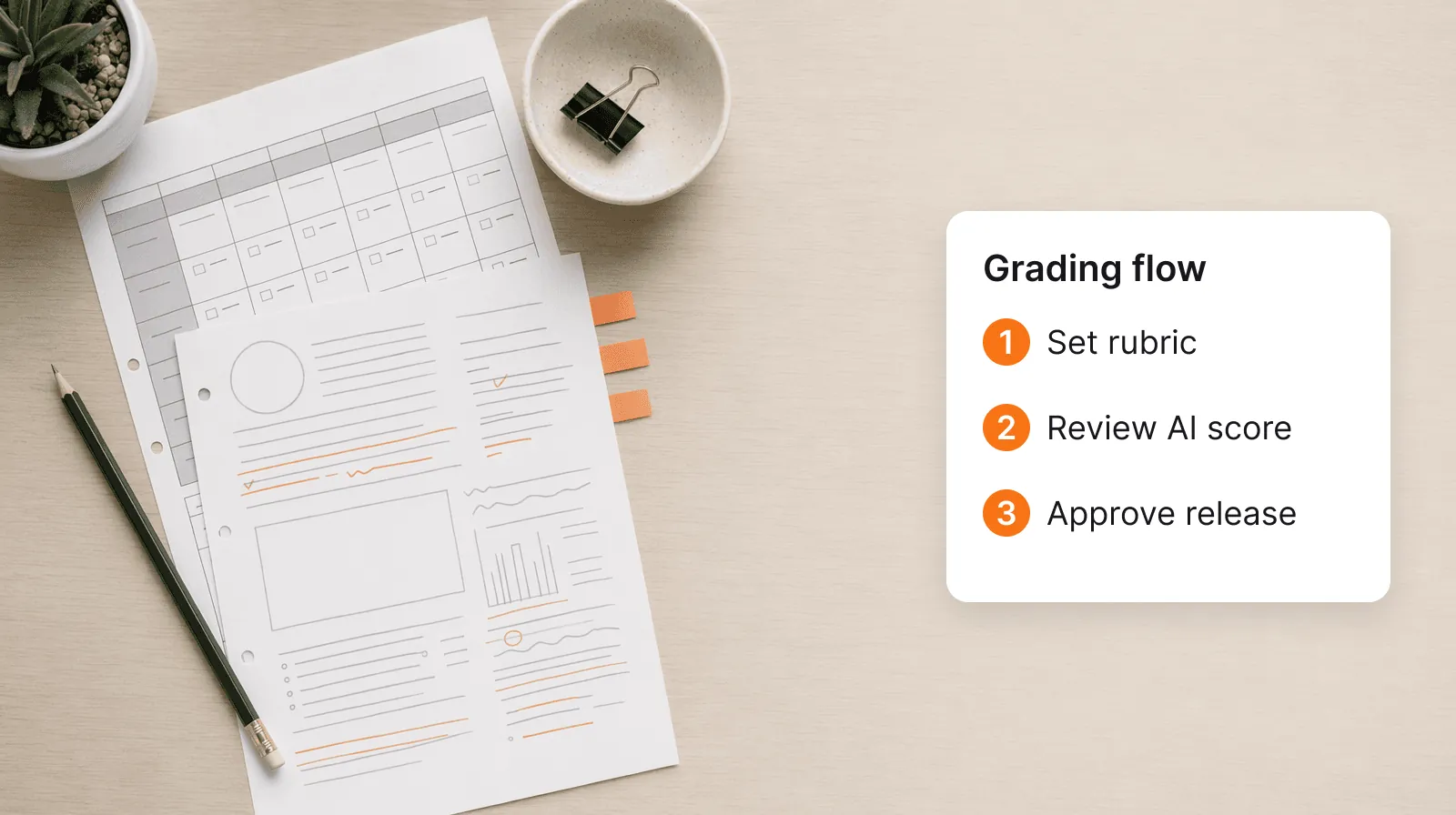
This sequencing is important. If AI generates a holistic grade first and the rubric is used afterward to justify it, faculty will distrust the output. If the rubric constrains the grading from the start, faculty can evaluate the suggestion against an agreed standard.
Assessment design determines whether AI helps or creates risk
Not every assessment is equally suitable for AI-assisted grading. A strong implementation starts by deciding where AI should support the instructor and where it should stay out of the final scoring path.
Good candidates often include:
- Short constructed responses with clear criteria
- Draft feedback on essays before final submission
- Lab reports with structured sections
- Reflection assignments assessed against participation or reasoning criteria
- Code explanations where rubric criteria are explicit
- Case-study responses with expected concepts and evidence
Poor candidates include:
- High-stakes exams with ambiguous answers
- Creative work where novelty is central to evaluation
- Oral performance assessments without reliable transcript review
- Assignments requiring specialized disciplinary judgment not captured in the rubric
- Any assessment where the rubric is vague or not shared with students
The middle category is where many colleges and universities will begin: AI can draft criterion-level feedback, identify likely rubric bands, and surface items for instructor attention, while the faculty member keeps final grading authority.
For example, in a 120-student introductory sociology course, the instructor may use AI to pre-score a short theory application assignment across four rubric criteria: concept accuracy, use of evidence, application to scenario, and clarity. The instructor then reviews low-confidence cases, spot-checks a sample of high-confidence cases, edits feedback where needed, and approves final grades.
That workflow is materially different from “AI graded 120 papers.” It is closer to “AI organized the first pass so the instructor could focus review time where it mattered.”
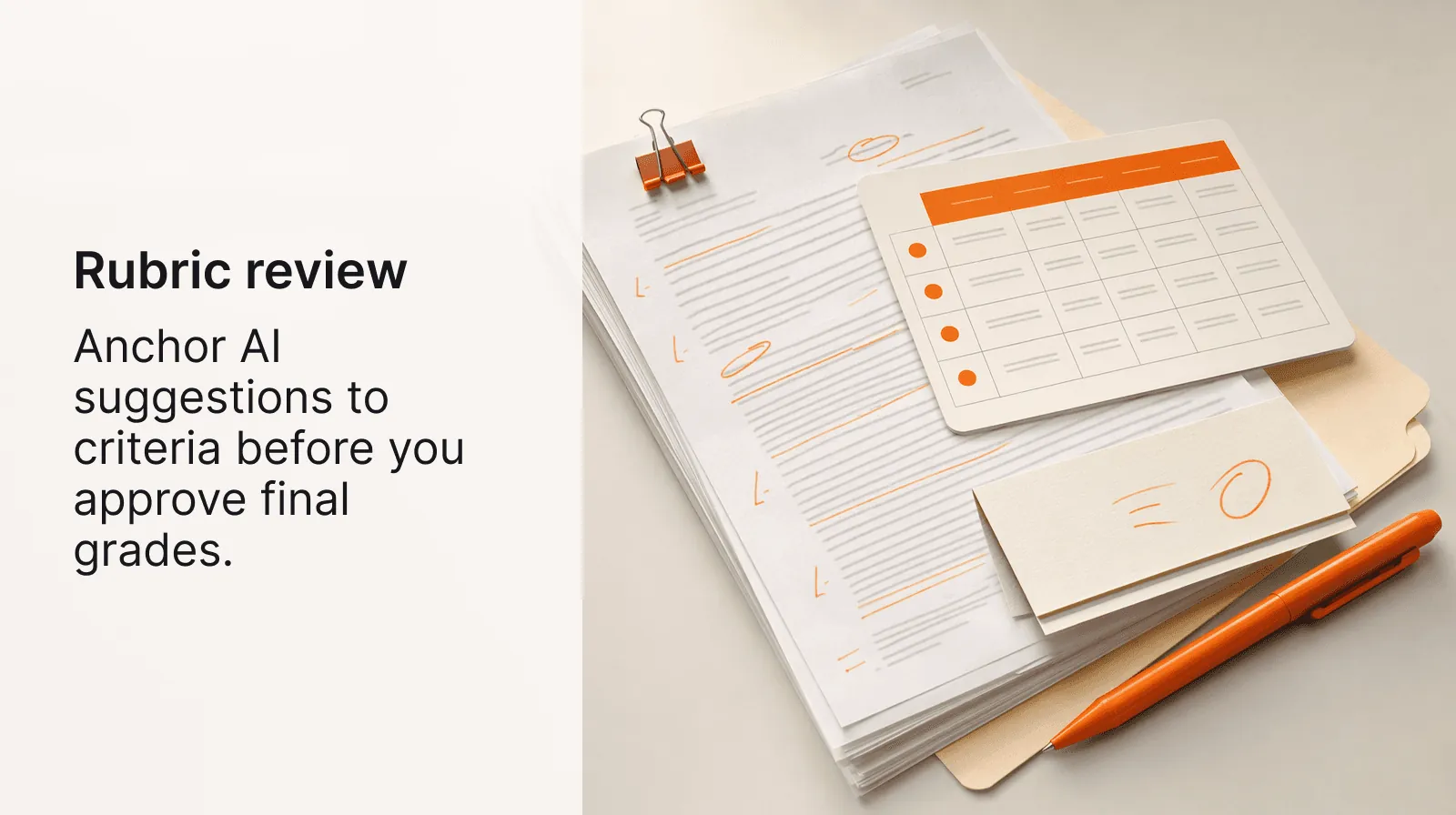
The image below belongs in the assessment design phase: it shows AI assistance as one layer inside a broader scoring and review process, not as a standalone grader.
A useful decision rule: if an instructor cannot describe how they would manually grade the work using the rubric, AI should not be asked to grade it either.
Overrides are not a fallback; they are the control surface
Faculty trust increases when AI recommendations are easy to change.
An override should not feel like fighting the system. It should be a normal part of the grading workflow. Instructors need to adjust scores, rewrite feedback, mark a submission for manual review, or reject an AI recommendation entirely.
A strong override model includes:
- Criterion-level edits: Change “Evidence: 3/5” without reworking the entire grade.
- Feedback editing: Keep useful comments, remove inaccurate ones, and add instructor-specific guidance.
- Bulk controls with caution: Apply a repeated correction across similar cases, but require review before release.
- Confidence indicators: Highlight submissions where the AI had limited evidence, conflicting signals, or rubric uncertainty.
- Escalation paths: Send flagged work to a lead instructor, teaching assistant, or program coordinator.
Consider a writing-intensive history course. The AI may correctly identify that a student used relevant sources, but miss that one source is interpreted out of historical context. The instructor should be able to lower the evidence score, add a note explaining the issue, and preserve the rest of the feedback if it is useful.
That is not a failure of AI grading. That is the expected workflow.
In higher education, trust does not come from pretending AI is always right. Trust comes from making expert correction fast, visible, and easy to apply.
Audit trails make grading defensible
An audit trail is what turns AI grading from a convenience into an accountable academic process.
At minimum, the system should record:
- The rubric version used
- The assignment and submission evaluated
- The AI-generated score and feedback
- Any instructor edits or overrides
- The final released grade
- The user who approved it
- Relevant timestamps
- Any regrading events or appeal-related changes
This matters for several reasons.
First, student grade challenges require evidence. If a student asks why they received a certain score, the instructor should be able to explain the rubric criteria and the final judgment clearly.
Second, departments need consistency. If multiple sections of a course use the same assignment, an audit trail helps coordinators see whether grading practices are aligned.
Third, institutions need policy confidence. Academic leaders and compliance teams are more likely to approve AI-assisted workflows when they can see that faculty remain in control and that decisions are reviewable.
The audit trail should not be designed as surveillance of instructors. It should be designed as protection for instructors, students, and programs. It documents the difference between an AI suggestion and an approved grade.
Practical checklist for evaluating AI grading tools
Before adopting AI grading in a course, program, or institution, use this checklist with faculty, instructional designers, and academic technology staff.
The checklist below is intended for final QA before piloting or scaling an AI grading workflow.
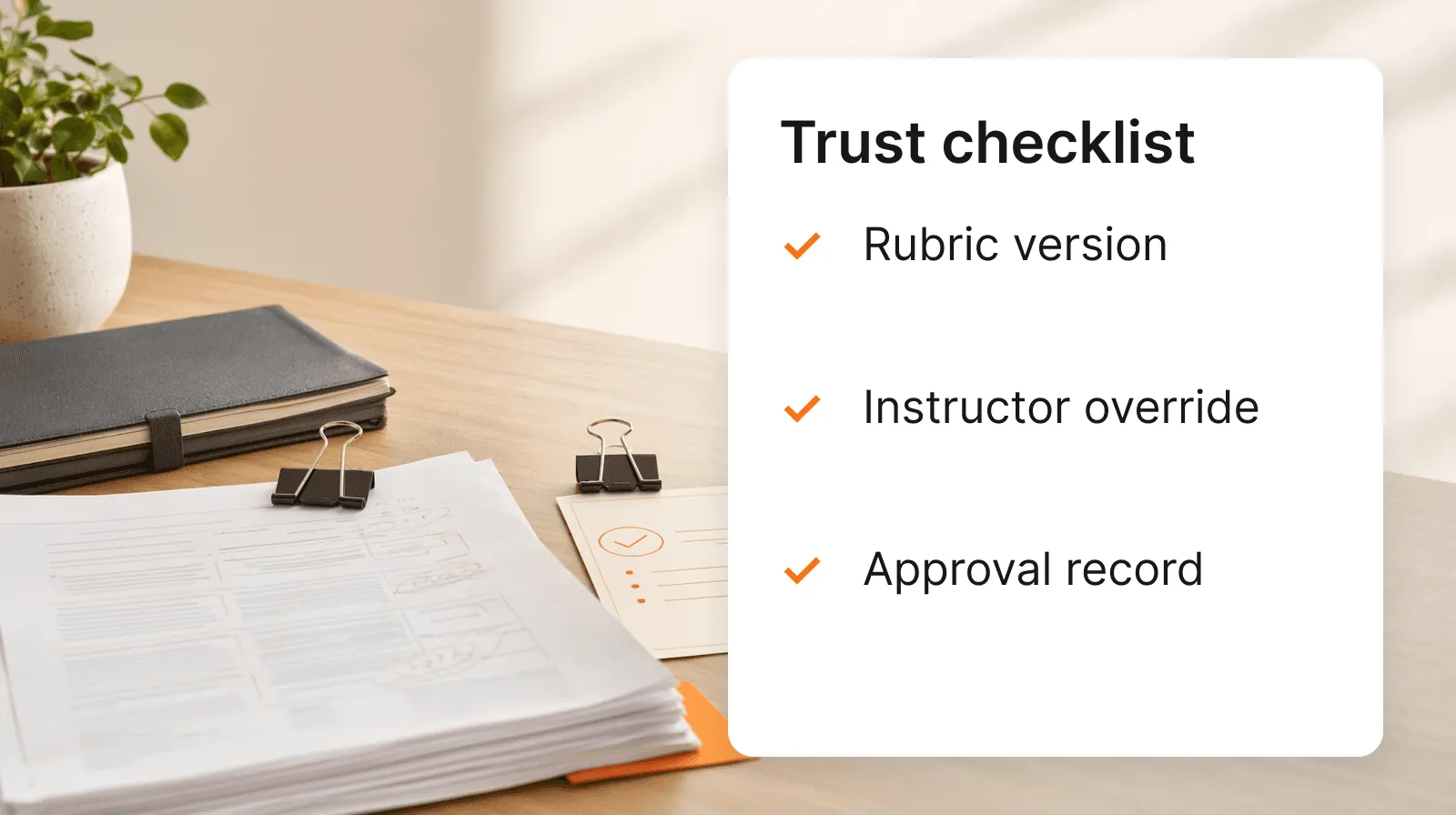
- The rubric is explicit, criterion-based, and reviewed by the instructor.
- AI output is tied to rubric criteria, not only a holistic score.
- Instructors can override scores before grades are released.
- Feedback can be edited, removed, or rewritten.
- Low-confidence or unusual submissions are flagged for manual review.
- The system records the AI suggestion and the final instructor decision separately.
- Rubric versions are preserved so past grades remain explainable.
- Students receive feedback that is accurate, useful, and aligned with the rubric.
- The workflow supports grade appeals and regrading.
- The tool fits existing course operations, including LMS or gradebook processes where needed.
- Faculty understand what AI is doing and what it is not doing.
- A pilot includes spot checks for bias, inconsistency, and over-scoring fluent but weak work.
The most important item is separation of roles: AI suggests, faculty decide, and the system records the path.
Decision criteria for higher education teams
For a single instructor, the key question is: “Will this save time without lowering my grading standards?”
For a department or institution, the criteria are broader.
Look for AI grading workflows that support:
- Academic control: Faculty own rubrics, grading policies, and final approval.
- Operational repeatability: The same workflow can be used across sections without relying on private prompts.
- Transparency: Students and faculty can understand how feedback maps to criteria.
- Reviewability: Scores, overrides, and releases are traceable.
- Integration readiness: Grades and feedback can move into existing course systems without manual copy-paste.
- Pilotability: The tool can be tested on one assignment before scaling.
- Policy alignment: The workflow supports institutional expectations around privacy, records, appeals, and accessibility.
A useful pilot design is to start with one assignment that is meaningful but not the highest-stakes assessment in the course. Run AI suggestions in parallel with instructor grading. Compare rubric bands, review discrepancies, and decide where the tool is reliable enough to support future grading.
The goal of the pilot is not to prove AI is perfect. It is to identify the parts of grading where AI reliably reduces repetitive work and the parts where faculty judgment must remain primary.
FAQ
Can AI grading be used for high-stakes university assessments?
It can support parts of the process, but high-stakes assessments should require stronger controls: explicit rubrics, instructor approval, audit trails, appeal procedures, and careful piloting. Many institutions will start with lower-stakes or draft-feedback use cases before applying AI to final grades.
How is rubric-based AI grading different from using ChatGPT?
Rubric-based AI grading constrains the AI to specific criteria, records suggestions, allows instructor overrides, and preserves a reviewable history. A one-shot ChatGPT prompt may produce useful comments, but it usually lacks consistent workflow controls, gradebook integration, and auditability.
Should students be told when AI helps generate grading feedback?
In most higher education contexts, transparency is the safer default. Students should understand that AI may assist with draft scoring or feedback, while the instructor retains responsibility for the final grade. Institutions should align disclosure language with their academic and technology policies.
The trust pattern: structure before speed
AI grading will not be trusted because it is fast. It will be trusted when it is structured.
For faculty, the winning pattern is clear: start with the rubric, use AI for a constrained first pass, review and override easily, then preserve an audit trail of what happened. That structure respects the professional responsibility of grading while reducing the repetitive burden that consumes so much teaching time.
In TutorFlow’s view, the future of AI grading in higher education is not an autonomous grader hidden behind a score. It is an accountable workflow where educators remain in charge and AI handles the parts of the process that can be made consistent, reviewable, and useful.