What happened
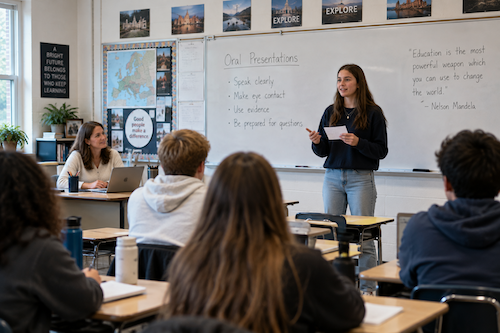
eSchool News reported that Catherine Hartmann, a University of Wyoming professor, brought back oral assessment after a 2023 student in her history of meditation course submitted a reflective paper with the copied AI prompt still at the top. Hartmann then redesigned an upper-level humanities course so discussions and oral practice led to a final oral exam.
Why it matters
The account frames oral exams less as an anti-cheating tool than as a way to see reasoning in motion. It cites University of Pennsylvania mathematics professor Robin Pemantle, who has students solve calculus problems at the board while explaining their reasoning aloud. For educators and learning designers, the practical issue is not only whether AI touched a product, but whether learners can explain choices, defend interpretations, adapt when conditions change, and show ownership of ideas they present.
What to do next
Consider oral components where they align with learning goals, especially in courses where written artifacts alone may not show process. Build them through backward design: regular low-stakes explanation, discussion, rehearsal, and questioning before any high-stakes exam. Set criteria that separate subject understanding from fluency under pressure. The article specifically cautions that multilingual learners’ hesitation, accent, vocabulary retrieval, or processing time should not be mistaken for weak knowledge. Keep essays and projects where they fit; the evidence supports broadening assessment, not replacing it.
About this briefing
Reviewed by TutorFlow Editorial. We link the primary source, preserve its publication date, and distinguish reported claims from TutorFlow analysis. Our commentary focuses on practical decisions for educators and training teams.
Discussion (0)
Open to everyone