How AI Math OCR Converts Handwriting to Digital Text
Mathematics remains one of the few subjects where handwritten work still dominates. Students solve equations in notebooks, teachers model problems on whiteboards, and much of STEM thinking happens through sketches, symbols, and diagrams. While digital learning platforms continue to grow, handwritten math often remains stuck on paper, making it difficult to search, edit, reuse, or share.
Optical Character Recognition (OCR) is becoming an essential tool for bridging this gap. Modern AI OCR tools, including image to text AI systems and dedicated math OCR tools, can now recognize handwriting, mathematical structures, and symbols. According to research from the EdWeek Research Center, 9 in 10 educators report that artificial intelligence has changed the job of teaching at least a little, with 42 percent saying AI has changed the profession "a fair amount" or "a lot." Teachers are increasingly using AI tools to save time on routine tasks, with tools that automate transcription helping educators focus more on instruction and meaningful interaction with students. OCR directly supports this need by turning handwritten equations into editable digital text.
In this article, we explore what OCR is, why it matters for STEM instruction, and how TutorFlow's math OCR tool helps educators digitize formulas, diagrams, and handwritten equations quickly and accurately.
What Is OCR and Why It Matters in STEM
Optical Character Recognition, often called OCR, is a technology that analyzes an image and extracts the text inside it. Traditional OCR tools were designed for printed documents, but AI-powered models can now recognize handwriting and mathematical layout more effectively.
Research from the Brookings Institution highlights that AI tools, when integrated thoughtfully into instruction, can improve accessibility and lighten administrative workload. Their framework emphasizes transparency, accountability, and human-in-the-loop design to ensure AI tools enhance rather than replace professional judgment.
In math classes, OCR becomes especially useful because equations are nonlinear. Fractions, exponents, and symbols require structural interpretation. Studies from the Journal of Educational Technology and Society and arXiv show that mathematical notation demands specialized OCR models because equations must be interpreted as structured objects rather than isolated characters.
For STEM classrooms, OCR and AI OCR tools support:
- Faster creation of digital worksheets
- Easier sharing of handwritten notes
- Better organization for students
- Smoother integration with digital platforms
- Improvements in accessibility and readability
OCR helps transform analog math into flexible, editable digital content.
Why Math Requires Specialized OCR
Math is inherently visual. Symbols are positioned above, below, and beside each other in ways that cannot be interpreted using standard text recognition. Research from IEEE and Nature Research Intelligence confirms that structure-aware models significantly improve recognition accuracy.
Mathematical expressions involve spatial, two-dimensional structures. Modern handwritten mathematical expression recognition (HMER) systems must recognize symbols and parse structures simultaneously.
This is essential for interpreting:
- Superscripts
- Fractions
- Greek letters
- Integrals
- Sigma notation
- Radicals
- Matrices
A generic OCR tool cannot reliably process these features. A dedicated math OCR tool is required to reconstruct meaning, not just extract characters.
TutorFlow's Math OCR Scanner for Formulas
TutorFlow provides a dedicated math OCR tool for converting handwritten notes and equations into digital text.
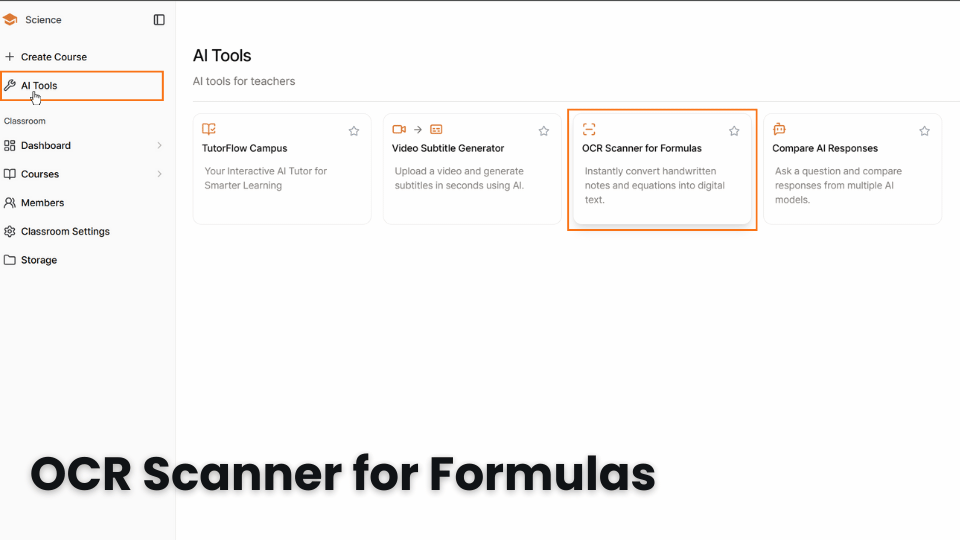
How TutorFlow's OCR Tool Works
TutorFlow’s AI OCR tool uses models trained specifically on handwritten mathematical notation. When users upload or draw an image, the system analyzes stroke patterns, symbol placement, and spatial structure.
It supports:
- Algebra
- Calculus
- Geometry
- Trigonometry
- Scientific formulas
- Matrices and vectors
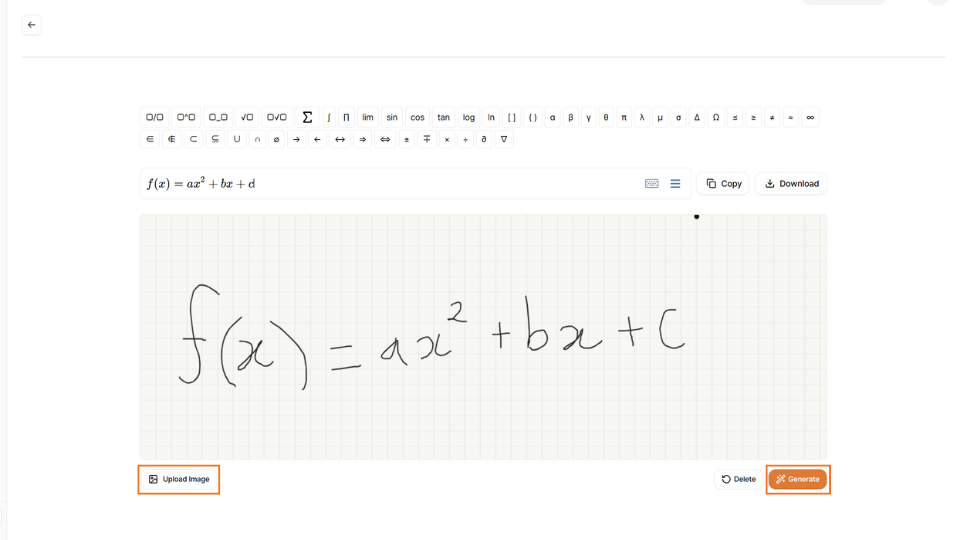
Upload Handwritten Notes
Teachers can upload worksheet pages, whiteboard photos, or notebook images. Research from the Walton Family Foundation shows that teachers using AI tools save an average of 5.9 hours weekly.
Automatic Math Recognition
Modern recognition models can identify symbols and their spatial relationships, but accuracy varies with handwriting, image quality, notation, and the model used. Teachers should review extracted equations before publishing or grading from them.
Equation Editing Toolbar
Teachers can refine extracted math with:
- Symbol shortcuts
- Fractions & exponents
- Alignment tools
- Matrix templates
Copy & Download Options
Equations can be exported or pasted into lesson plans, LMS platforms, or worksheets.
Advanced Context Menu
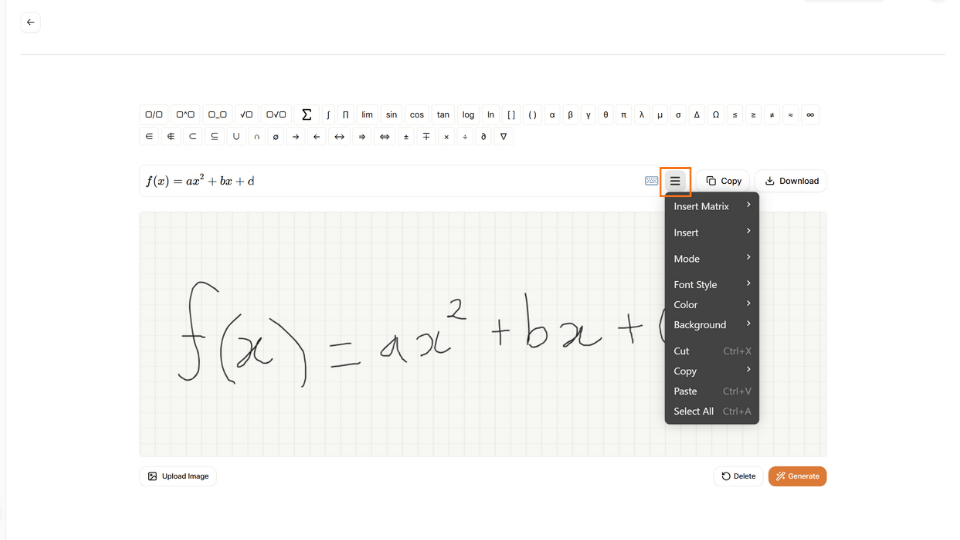
The interface supports both quick editing and precise control.
How OCR Supports Better Math Learning
Faster Material Preparation
Teachers spend up to 29 hours weekly on non-teaching tasks. Reducing transcription time increases capacity for lesson design and student support, according to the Stanford EdPolicy Research Initiative.
Improved Accessibility
Digitized math supports:
- Screen readers
- Adjustable formats
- Searchable notes
This aligns with UDL Principles from CAST and research from Perkins School for the Blind and Microsoft Accessibility.
Better Hybrid & Online Learning
Handwritten submissions can be digitized for grading or AI-supported feedback, which is useful in hybrid learning environments. By converting physical notes, worksheets, and exam responses into editable digital text, the OCR system helps instructors review work remotely. Students in blended or fully online courses can also submit their work more conveniently. Teachers should compare the extracted notation with the original before using it for assessment.
Integration With Math Solver Tools
While TutorFlow's OCR is not a math solver, its clean digital output works seamlessly with external solver platforms, graphing tools, and tutoring systems. By providing accurate text-based representations of equations and expressions, it ensures compatibility with a broad range of computational tools. Students can easily move from handwritten work to digital assistance, enabling step-by-step guidance, graph visualizations, or symbolic manipulation from third‑party applications. This interconnected workflow enhances learning efficiency and supports deeper mathematical exploration.
Start Now With TutorFlow!
OCR is a practical way to connect handwritten math to digital teaching materials. TutorFlow's math OCR tool helps teachers convert equations for editing, review, and reuse.
👉 Try the Math OCR Tool: /tools/ocr